Air restriction is a quiet warning that diesel engines often give before performance declines. Dust, moisture, and compacted debris can narrow the filter’s breathing path. The result may be darker exhaust, slower acceleration, higher fuel use, or premature turbocharger stress. Learning how to measure air filter restriction in diesel engines helps technicians identify this problem before it becomes an expensive repair.
Industry guidance supports measurement rather than guesswork. SAE J726 and ISO 5011 describe standardized approaches for evaluating engine air-cleaner performance and restriction. Donaldson and Cummins Filtration technical documents commonly express restriction in inches of water or kilopascals. Many heavy-duty systems use restriction indicators installed near the filter outlet, where readings reflect the engine’s actual air demand. A clean filter does not always mean a low reading. It may still be incorrectly sealed.
Measure under load.
This detail matters. A diesel engine can show an acceptable reading at idle while creating significant restriction during acceleration, climbing, or full-load operation. Technicians should follow the equipment manufacturer’s test point, temperature requirements, and maximum allowable specification. Removing the filter for a quick comparison is unsafe and can introduce abrasive dust. It also produces a misleading result. Field experience suggests that damaged seals, blocked ducts, and inaccurate gauges deserve equal attention. The filter is only one part of the intake system.
This guide connects practical inspection with manufacturer limits and recognized testing principles. It also acknowledges an uncomfortable truth: a single number rarely explains the whole failure. Sound diagnosis requires a gauge, a controlled operating condition, visible inspection, and careful records.
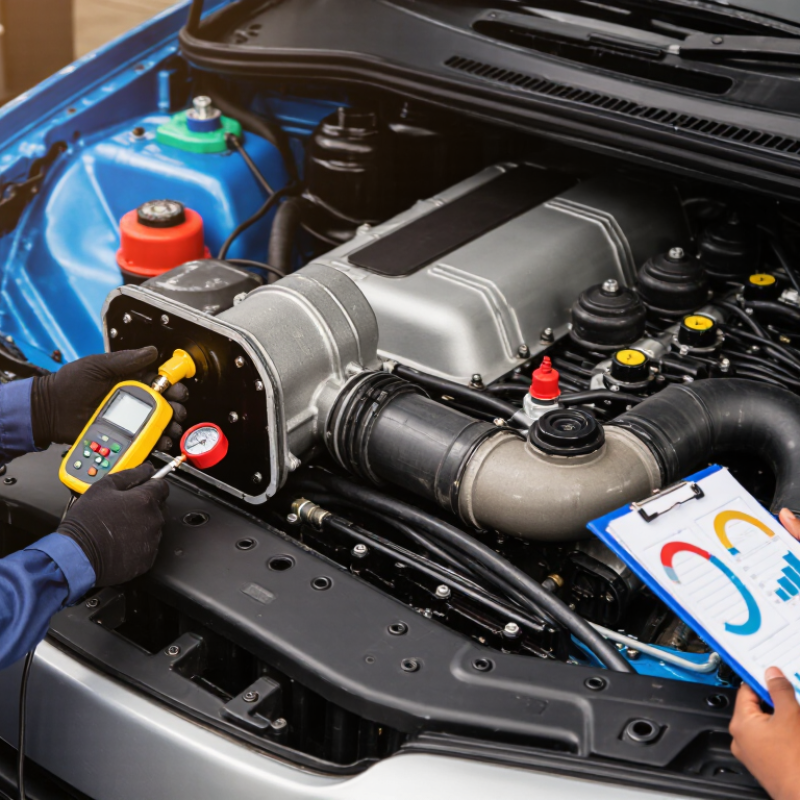
Air filter restriction describes the pressure loss caused by dirt, moisture, or a damaged filter element. In diesel engines, this restriction reduces airflow before combustion. The engine may then smoke, respond slowly, or consume more fuel. A clean-looking filter can still be restrictive, especially after fine dust exposure.
Measure restriction with a calibrated manometer or electronic pressure gauge. Connect the gauge across the filter housing, following the engine manufacturer’s test points. Check the reading at rated speed and under load, not only at idle. Idle readings can appear normal. Record the value in kPa or inches of water, then compare it with the specified service limit. Never guess the limit from another engine.
Inspect the housing, seals, intake duct, and restriction indicator during the test. A loose clamp can draw unfiltered air, while a blocked duct can imitate a dirty filter. Replace the element only when testing confirms excessive restriction, unless it is visibly wet, damaged, or contaminated. In practical maintenance, technicians sometimes tap a filter and see dust fall out, but that action can damage the media. I used to view a low reading as reassuring; later checks showed leaks around the seal were hiding the real problem. The measurement must be interpreted with the whole intake system in mind.
How to Measure Air Filter Restriction in Diesel Engines?
Preparing the engine and measuring equipment correctly prevents misleading readings. Park the diesel engine on firm, level ground, then apply the parking brake. Let hot components cool enough for safe access. Wear eye protection and keep loose clothing away from moving parts. Inspect the air intake housing, clamps, hoses, and filter seal. A small crack can create an unfiltered air path and distort the diagnosis. Check that the filter is properly seated, but do not clean or disturb it before testing.
Use a calibrated restriction gauge or differential manometer designed for diesel intake systems. Select a pressure range suitable for the expected reading. With the engine stopped, connect the sensing line to the approved test port between the filter and turbocharger inlet. Keep the tube short, secure, and free from sharp bends. Zero the gauge before starting. I have seen readings drift when moisture entered the tube. That detail is easy to miss.
Start the engine and check for leaks around the connection. An idle reading may look reassuring, but it rarely represents the engine’s real breathing demand. Measure restriction at the specified operating speed and load, following the engine service data. If a dynamometer is unavailable, use a controlled working condition approved by a qualified technician. Record the pressure, engine speed, load, temperature, and filter condition. Repeat the measurement if the result changes suddenly. A questionable reading deserves another check, not an immediate filter replacement.
How to Measure Air Filter Restriction in Diesel Engines?
A vacuum gauge provides a practical way to check air filter restriction. Install the gauge upstream of the turbocharger and downstream of the air filter. This location measures the vacuum created as the engine pulls air through the filter. Keep the hose short, secure, and free from cracks. A loose connection can create a false reading.
Warm the diesel engine fully before testing. Restriction may appear low at idle, so test near the engine’s governed speed under load when possible. Follow the equipment manufacturer’s safety procedure. Watch the gauge while the engine works steadily. Compare the reading with the service limit listed for that engine. High restriction can indicate a dirty filter, blocked intake duct, collapsed hose, or water inside the housing. Do not replace the filter by guessing. A clean-looking filter can still restrict airflow. That is easy to overlook.
Tips: Check the gauge’s zero position before starting. Record readings at idle and under load. Inspect the hose after testing. Never confuse turbocharger boost pressure with intake restriction. If the reading changes sharply, repeat the test. My own preference is to confirm the result with a second inspection, because one imperfect connection can mislead the entire diagnosis. A low reading does not prove everything is healthy; an air leak may bypass the filter completely.
| Measurement Dimension | Correct Method or Reference | Typical Reading or Data | Interpretation | Recommended Action |
|---|---|---|---|---|
| Measurement location | Connect the vacuum or restriction gauge to a test port in the intake duct between the air filter outlet and the turbocharger inlet. Use the designated test port when one is provided. | Filter outlet side | A reading taken upstream of the filter will not show the restriction imposed by the filter accurately. | Inspect the hose, fitting, and gauge connection for air leaks before testing. |
| Gauge scale | Restriction is commonly displayed as inches of water column or kilopascals. | 1 inH₂O ≈ 0.249 kPa 1 kPa ≈ 4.02 inH₂O |
Both units measure the pressure loss caused by the intake system. | Use the same unit as the engine service specification when comparing the reading with the limit. |
| Engine condition before testing | Check that the air intake is assembled correctly, the filter housing is closed, and the engine is at normal operating temperature. | Warm engine | A cold engine or an incorrectly assembled intake can produce misleading results. | Correct damaged clamps, seals, hoses, or housing covers before recording a restriction value. |
| Gauge zero check | With the engine stopped and the gauge disconnected from engine vacuum, the pointer should return to zero. | 0 inH₂O / 0 kPa | A non-zero starting point indicates a gauge or hose problem. | Repair, replace, or recalibrate the gauge before testing. |
| Idle reading | Start the engine and observe the gauge at idle after it has stabilized. | Usually low; often below 2 inH₂O (below approximately 0.5 kPa) |
Idle airflow is limited, so idle readings normally do not reveal the maximum filter restriction. | Do not approve or reject a filter based only on the idle reading. |
| High-load test | Observe the gauge while the engine is operating at the highest safe practical load and speed specified for the equipment. | Record the highest stable reading | The greatest restriction usually occurs when the engine demands the most air. | Follow the equipment service procedure and avoid unsafe operation or overspeeding. |
| Low restriction | Gauge remains close to zero during the high-load test. | Approximately 0–5 inH₂O (0–1.25 kPa) |
The filter and intake path are offering relatively little resistance under the tested condition. | Continue routine inspection; also check that the gauge is connected to the correct location. |
| Moderate restriction | Reading is clearly above the normal baseline but remains below the specified service limit. | Approximately 5–15 inH₂O (1.25–3.74 kPa) |
The filter may be loading with dust, although the result is not automatically a replacement decision. | Inspect the filter, dust-evacuator valve, intake duct, and service indicator; compare with the engine specification. |
| High restriction | Reading approaches or exceeds the limit stated in the engine or equipment service documentation. | Common alert range: about 15–25 inH₂O (3.74–6.23 kPa) |
High restriction can reduce available air, increase smoke, lower power, and increase intake vacuum. | Replace or service the filter only according to the approved procedure, then repeat the test. |
| Engine-specific maximum | The allowable restriction is determined by the engine and intake-system design, not by a universal value. | Use the published service limit | Some engines permit values above or below commonly used field ranges. | Never substitute the general ranges in this table for the manufacturer’s service specification. |
| Restriction that does not decrease after filter replacement | Repeat the high-load test with a correctly installed, clean filter. | Reading remains high | The restriction may be caused by a collapsed hose, blocked pre-cleaner, obstructed duct, undersized intake, or faulty housing component. | Inspect the complete air path from the intake opening to the turbocharger inlet. |
| Restriction that changes rapidly | Watch the gauge during acceleration, load changes, and deceleration. | Rapid fluctuation or pulsing | Possible causes include a loose connection, damaged hose, gauge-line issue, or unstable airflow. | Check the gauge line and intake components before interpreting the reading as filter loading. |
| After-service verification | Reset the service indicator if applicable, run the engine under the same test conditions, and record the new maximum value. | New reading should be lower if the filter was the restriction source |
A repeatable reduction confirms that the filter contributed significantly to the restriction. | Document engine speed, load, ambient conditions, gauge units, and the final reading. |
| Safety requirement | Keep clear of rotating parts, hot surfaces, belts, fans, and moving equipment during the test. | Use approved test conditions | High-load testing can require a dynamometer, controlled work area, or trained operator. | Follow site safety rules and the equipment manufacturer’s operating instructions. |
Important: The numerical ranges shown are general field-reference values, not universal replacement limits. Always use the service specification for the particular diesel engine and intake system. A vacuum gauge measures intake restriction; it does not by itself determine filter condition, engine health, or the cause of poor performance.
Air filter restriction shows how hard a diesel engine must work to draw clean air. Measure it with a calibrated vacuum gauge or manometer connected at the specified test port. Take the reading while the engine operates under its rated speed and load, because an idle reading can look falsely reassuring. Record the unit carefully, such as kPa or inches of water.
Interpret the result against the engine manufacturer’s service limit, not a universal number. A rising reading indicates increasing resistance, often caused by dust, moisture, or a blocked pre-cleaner. High restriction may bring black smoke, slower acceleration, higher fuel use, or unusual turbocharger response. Do not replace the filter only because it looks dirty. Some dust indicates effective filtration. However, a low reading does not always prove the system is healthy. A damaged seal, loose duct, or incorrect gauge connection can hide a serious problem.
Tips: Test at the same operating condition each time and write down the reading, engine load, and filter hours. Inspect the housing and sealing edges before changing parts. Avoid blowing compressed air through disposable filter media, since this can create invisible damage. One practical mistake is trusting a single measurement. Repeat the test when results conflict with engine symptoms, and question the test setup before blaming the filter.
Measure the pressure difference across the air filter at rated engine speed and full load. Restriction is commonly reported in kilopascals (kPa); 6.2 kPa is approximately 25 inH₂O, a commonly used service-limit reference for many heavy-duty diesel applications.
Readings below 3.0 kPa generally indicate low restriction, readings from 3.0 to 6.2 kPa indicate increasing loading, and readings at or above 6.2 kPa require inspection and servicing according to the engine manufacturer's specifications. Service limits vary by engine and intake system.
Air filter restriction shows how hard a diesel engine must work to draw clean air. Connect a calibrated restriction gauge or manometer to the intake side, after the filter and before the turbocharger. Keep the connection sealed. A loose hose can create false readings.
Measure at idle, then repeat under full load or the engine’s specified test speed. Restriction often appears normal at idle but rises sharply during acceleration. Compare the reading with the engine manufacturer’s service limit. Do not judge the filter by appearance alone. A filter may look clean while fine dust blocks its inner passages. I once trusted a visual inspection. That shortcut was wrong.
If restriction is high, inspect the filter element, housing, seals, intake duct, and rain cover. Look for wet paper, collapsed pleats, oily deposits, or dust tracks around the gasket. Water can deform the media. A damaged intake hose may also limit airflow. Remove the filter only in a clean area, because loose dust can enter the engine. After installing a verified replacement, repeat the same loaded test. The pressure should fall clearly. If it does not, investigate the ducting, turbocharger inlet, or sensor connection. Record the reading, engine condition, and operating speed. Small details matter. A single unloaded test can mislead maintenance decisions.
It means airflow loses pressure before combustion. Dirt, moisture, or damage can cause this resistance.
The engine may produce black smoke, respond slowly, or use more fuel. Turbocharger response may also feel unusual.
Use a calibrated manometer or electronic pressure gauge. Connect it across the filter housing at the specified test points.
No. Test at rated speed and under load. Idle readings can look normal and still hide restriction.
Record the result in kPa or inches of water. Write down the engine load and operating condition too.
Compare the reading with the engine’s specified service limit. Do not borrow a limit from another engine.
Yes. Fine dust may clog the filter deeply. Appearance alone is unreliable.
Check the housing, seals, intake duct, clamps, and restriction indicator. A blocked duct can imitate a dirty filter.
No. A loose seal or gauge connection can hide the real problem. I once trusted a low reading too quickly.
Avoid it. Compressed air can create invisible damage. Recheck the test when symptoms and readings disagree.
Learning how to measure air filter restriction in diesel engines is essential for maintaining proper airflow, fuel efficiency, and engine performance. Air filter restriction occurs when dust and debris limit the amount of air entering the engine. To measure it accurately, first warm the engine according to normal operating conditions and inspect the intake system for loose connections or damage. Then connect a suitable vacuum or restriction gauge to the designated test point, ensuring all fittings are secure and the equipment is correctly calibrated.
With the engine running under the specified test condition, observe the pressure reading and compare it with the engine manufacturer’s service limit. A high reading may indicate a clogged filter, blocked intake duct, collapsed hose, or another airflow problem. A normal reading does not always prove the filter is in perfect condition, so the filter should also be inspected for contamination, moisture, or physical damage. Confirm the diagnosis by checking the entire intake system before replacing or servicing components.

Fisc Auto